
Most people buy a scratchcard the same way they grab a pack of gum — impulsively, without much thought, at the checkout counter. They scratch it in the car, lose, and forget about it within minutes. But a small group of players approach scratchcards differently. They study them. They track them. They apply actual logic to what most people dismiss as pure luck. This guide is for that second type of player.
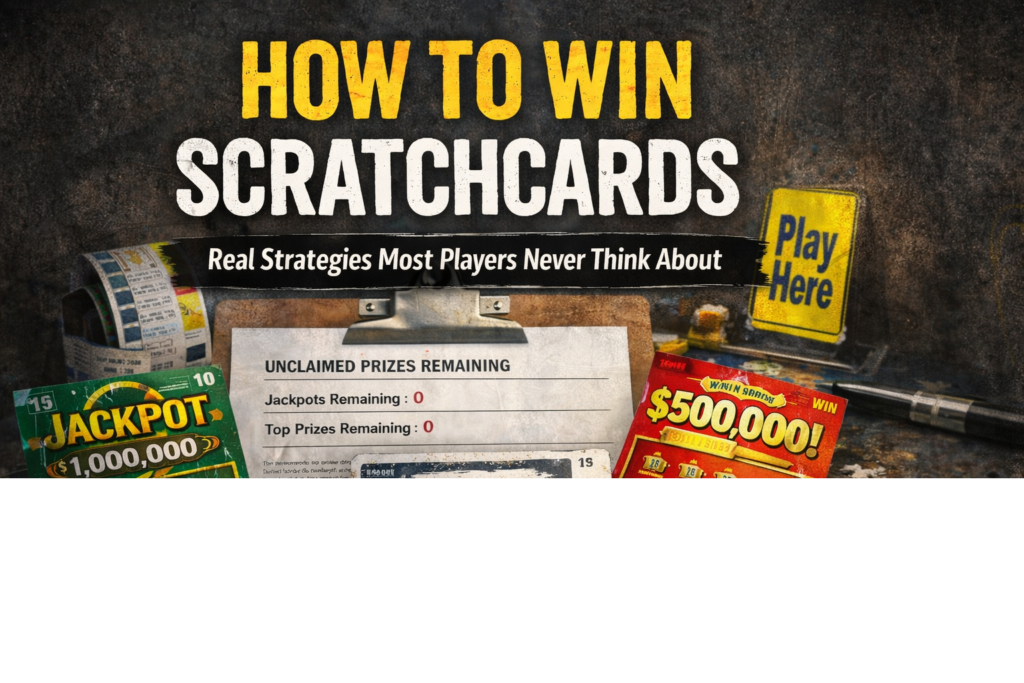
Let’s Be Honest First
Before we get into the strategies, let’s say something that most scratchcard articles don’t have the guts to say clearly:
Scratchcards are designed so that the house always wins over time.
That’s not cynicism. That’s mathematics. Every scratchcard game is engineered to pay out less than it takes in. The lottery commission keeps a percentage — typically 30 to 50 cents of every dollar spent — regardless of how smart you play.
So why does any of this matter?
Because within that unfavorable structure, there are still better and worse decisions you can make. You can’t beat the house long-term, but you absolutely can tilt the odds in your favor within a single session — choosing better tickets, avoiding dead games, and extracting every possible edge out of your spend.
That’s what this guide is actually about. Not magic. Not guarantees. Real, logical improvements to how you play.
Tip 1: Skip the Cheap Tickets — Always
This is the single most impactful decision most casual scratchcard players get wrong.
Walk into any newsagent or lottery retailer and you’ll see a rack of cards ranging from about £1 or $1 all the way up to £10, £20, or even £30 per card. Almost everyone gravitates toward the cheaper end. The logic seems obvious — buy more cards, more chances to win.
But that logic is backwards.
Cheaper cards carry smaller prize pools. When you buy a £1 card, the maximum prize is typically a few hundred pounds. When you buy a £10 card, you’re playing for jackpots that can reach six or seven figures. The percentage of tickets printed as winners is often similar across price points — but the size of those wins is vastly different.
Think about it this way: five £2 cards and one £10 card both cost you the same £10. But those five cheap tickets are each fighting for a much smaller prize pool with significantly worse top-end value. The single expensive ticket gives you one shot at something genuinely life-changing.
The smarter play: Spend less, spend better. Fewer expensive cards beat more cheap ones almost every time when you’re chasing meaningful wins.
Tip 2: Read the Back of the Card — Every Time
Most scratchcard players never read the odds printed on the back of the card. That is a genuinely baffling decision, given that those odds are printed right there for free.
Every scratchcard in most regulated markets is required by law to display the overall odds of winning any prize. You’ll see something like “Overall odds: 1 in 3.5” — meaning roughly one in every three and a half cards wins some amount. Some games run closer to 1 in 4 or 1 in 5. That difference is significant when you’re buying multiple cards.
But the back of the card tells you more than just the overall odds. It lists the prize breakdown: how many top prizes exist in total, how many second-tier prizes, and so on. And crucially, it tells you the original print run — how many cards were manufactured for this game.
Cross-reference that with what’s available on your lottery’s official website, and you can figure out something genuinely useful: how many top prizes are still out there.
If a game launched with three jackpot prizes and all three have already been claimed, you are playing a dead game. The cards still exist on the shelf, they’re still being sold, but the best reason to play that particular game is gone. Move to a different game.
This is not speculation. Most national lotteries update their prize information publicly. It takes two minutes to check. Those two minutes can save you real money.
Tip 3: The Expected Value Calculation — Playing Like a Statistician
Here’s a concept that serious gamblers use constantly but almost no casual scratchcard player has ever heard of: expected value.
Expected value is the average return you’d get per pound or dollar spent if you played a game an infinite number of times. It’s the mathematical reality underneath all the excitement.
For most scratchcard games, the expected value sits somewhere between 50 and 70 pence per £1 spent — meaning you’re expected to lose between 30 and 50 pence on every card over the long run, no matter what.
But here’s where it gets interesting.
As a game ages and top prizes get claimed, the remaining prize pool shrinks while unsold tickets stay on the shelves. This actually makes the expected value of the remaining tickets worse in some cases — you’re still paying full price for a card that belongs to a game where the biggest prizes are gone.
The reverse is also true: a brand new game, freshly launched, with all its top prizes still unclaimed, has the highest expected value of its entire lifespan.
The practical takeaway: Look for newly launched scratchcard games. Ask your retailer when they received their current stock. The newer the game, the better your chances of accessing a top prize that’s still out there.
Tip 4: Bulk Buying From the Same Roll — There’s Real Logic Here
This is a strategy that floats around in scratchcard communities and gets dismissed as superstition. It’s actually grounded in something real.
Scratchcard manufacturers don’t distribute winning tickets randomly across every card they print. They distribute them according to a predetermined pattern within each roll or batch. This means winners are spread throughout a print run rather than clustered — and that means buying multiple cards from the same physical roll can mathematically affect your probability of encountering one of those wins.
The key phrase is “from the same roll.” Buying five cards spread across five different games doesn’t help you here. Buying five consecutive cards from the same £5 game in the same transaction, from the same roll, is the move.
Does it guarantee a win? Of course not. But it means you’re covering a stretch of a pre-structured distribution system, rather than dipping randomly into five separate ones.
Important caveat: Only do this with money you’ve already decided to spend. Bulk buying to chase a win you can’t afford is how casual players turn a hobby into a problem. The strategy only makes sense within a pre-set budget.
Tip 5: The Singleton Method — What the Professionals Know
This one requires a bit more patience and attention, but it’s arguably the most sophisticated technique available to scratchcard players.
The Singleton Method was pioneered by a Canadian statistician named Mohan Sri
vastava, who discovered a genuine flaw in certain types of scratchcards in the early 2000s. By analyzing the visible numbers printed around the edges of certain tic-tac-toe style cards, he found that numbers appearing only once — “singletons” — were statistically more likely to appear beneath the scratch surface as winning combinations.
He could predict winners with roughly 90% accuracy on the affected cards. He reported the flaw rather than exploiting it commercially, and lottery authorities quickly updated their card designs.
But here’s the important follow-up: not every lottery has updated every game.
Older game formats, particularly those with visible numbers printed in the margins, can still sometimes be analyzed using singleton logic. If you play games where external numbers are visible before scratching, it’s worth learning the basics of this method.
Even if the game you’re playing has been updated to prevent it, understanding the underlying principle — that visible elements of a card’s design can correlate with what’s underneath — trains your eye to notice patterns that most players walk right past.
Tip 6: Never Throw Away a Losing Ticket
This sounds like wishful thinking. It’s actually just common sense.
There are three reasons to hold onto every non-winning scratchcard you buy.
First: You might be wrong. The rules on scratchcards are sometimes genuinely confusing. Multi-tier prize structures, bonus games, hidden multipliers — it’s easier than you’d think to scratch a card, decide it’s a loser, and miss a small prize you didn’t notice. Always have a clerk scan your card before you bin it.
Second: Second-chance drawings exist. Many lottery organisations run periodic second-chance promotions where non-winning tickets can be entered into a separate draw. The odds in these draws are typically far better than the original game because participation rates are low — most people, like you previously, throw their tickets away. In 2024, a Maryland player reportedly won a $100,000 prize in a second-chance draw where fewer than 50,000 tickets had been entered. That’s dramatically better odds than any primary scratchcard game offers.
Third: Misprint claims. It’s rare, but lottery cards do occasionally have printing errors. In some jurisdictions, even a defective losing card can be submitted to the lottery authority for review. If a card has a genuine production fault, you may be entitled to compensation regardless of the printed result.
Keep your tickets for at least a month. The effort is minimal. The potential upside, even if unlikely, is real.
Tip 7: Know When a Game Is Dead — And Walk Away
This is the tip that separates players who think from players who just react.
Every scratchcard game has a finite number of top prizes. Once those are claimed, the game is mathematically exhausted at its highest level. The remaining tickets still exist, still get sold, still occasionally pay out smaller prizes — but the reason you bought that £10 card, the dream of the jackpot, is already gone.
Checking your lottery’s website takes about sixty seconds. Look up the game you’re considering. Find the remaining prizes section. If the top two prize tiers show zero remaining, put the card back and look for a game that still has big prizes in play.
This single habit — checking unclaimed prizes before buying — is probably the highest-return action a regular scratchcard player can take. It costs nothing. It takes almost no time. And it completely changes the quality of your decisions.
Tip 8: Build a Budget and Make It Sacred
None of these strategies mean anything if you don’t have a financial floor underneath them.
Scratchcards are designed to be addictive. The near-miss mechanic — where you reveal two matching symbols and need one more — is not an accident. It’s engineered to trigger the same neurological response as an actual win. Studies have shown that near-misses activate the brain’s reward circuitry almost identically to winning, which is precisely why they keep people buying.
Set a monthly scratchcard budget. Make it a number that, if you lost every penny of it, would not affect your life in any meaningful way. Think of it as entertainment spend — the same way you’d budget for a cinema trip or a meal out.
Once that budget is gone, stop. Don’t chase. Don’t borrow against next month. Stop.
The strategies in this article exist to help you get more value out of money you were already going to spend. They are not tools for spending more money. That distinction matters enormously.
Tip 9: Pick One Game and Commit to It
If you’re a regular player, the worst thing you can do is spread your budget across a dozen different games, buying one card here and one there.
Every game has its own odds structure, its own prize distribution, its own rhythm. When you spread across too many games, you never develop the kind of familiarity that helps you spot patterns, track remaining prizes, or understand how a particular game tends to behave.
Pick one game that’s newly launched, has strong remaining prizes, and has odds you’ve checked and accepted. Buy your cards for that game consistently. You’ll develop a much cleaner understanding of what you’re actually playing, and you’ll know exactly when it’s time to switch — when the top prizes dry up.
Tip 10: Understand the Maths — Then Play Anyway
Here’s the honest conclusion that most scratchcard guides dance around.
The mathematics of scratchcards will never be in your favour over the long run. The house edge is structural, it’s intentional, and it cannot be eliminated. Anyone who tells you otherwise is selling something.
But that doesn’t mean these strategies are pointless. They exist in the space between “completely random” and “completely rational” — and most players occupy the worst possible position in that space, buying impulsively, ignoring odds, playing dead games, and throwing away tickets that might still have value.
The player who checks unclaimed prizes, buys from newly launched games, skips the cheap cards, holds onto their tickets, and sets a firm budget is genuinely playing better than someone who doesn’t do those things. Not enough better to beat the house over a lifetime — but enough better to have more fun, last longer on the same budget, and occasionally hit something meaningful.
Scratchcards are entertainment. The tips in this guide are about making that entertainment smarter. Play within your means, apply what you’ve learned here, and enjoy the scratch.
Pkrspin.com.pk is your home for gambling strategy, poker guides, and honest advice on making the most of every game. Bookmark us for weekly content on everything from tournament poker to casino tips.
Sources & References
Casino.org — Top Tips To Improve Your Chances Of Winning Scratchcards.